Showing posts with label Alaska. Show all posts

Monday, September 6, 2010

Our Last Day of Adventure in Alaska


Thursday morning began with a hike through bear country in Idaho Bay. We didn't meet any of the furry critters, but we did find remarkable evidence of their presence.


Brown bear often step in the exact same spots year after year, following in the steps of their elders. You can see those tracks in the first photo.


Later in the morning, we headed to Dundas Bay for our longest kayak of the trip. We certainly needed the workout after eating so well on the boat.

This is a rare photo of Esther and Donald both paddling.

After a couple of miles (against the falling tide), we found about a dozen sea otters scattered across the water at the base of an island. The babies are quite large by this time of year, and some of the moms seemed a bit over-matched by their soon-to-be-independent pups.

Several harbor seals were also cruising the waters. As best as we could tell, this particular seal enjoyed sneaking up on mother sea otters and scaring them. A moment later, mama otter and her pup disappeared below the water in a cloud of spray.

Note: The first two photos are by other travelers on our expedition.

An Unexpected Amphibian

On the way out of Glacier Bay, we stopped at Barlett Cove, home of a excellent dock (where one fisherman had a 376 pound halibut), a visitor's center, and a beautiful trail through the temperate rain forest.

The trail begins with a stone marker that was placed at sea level in 1966. It now stands much higher. Why? Because the land is still rebounding from its centuries under the glaciers.

And then into the forest, where every surface seemed to be dripping with moss, lichen, and fungi. I kept expecting a hobbit to appear. Instead, we found something better: Alaska's only hopping amphibian, the Western Toad (formerly known as the Boreal Toad).

I don't think I would have spotted him if he had stayed still. His green color blends perfectly with the moss and lichens. But Mr. Toad decided to hop, which gave me a chance to pick him up to share with our fellow travelers.
When we reached the Visitor's Center, we realized how uncommon the toads are. On the bulletin board by the main entrance, the National Park Service posted a flyer asking for information about any toad sightings.

But that's not all it said. In bold letters, the flyer also advised: "Do not touch or apprehend. Toad carries deadly fungus."

Yikes, that seems like the sort of thing they ought to tell you before you can get on the trail. I was going to wash my hands anyway, but this added some urgency. And then a light bulb went off, and I realized that they meant deadly to other toads. That made more sense. And is a good reason I won't pick up any more Western Toads.

One Slight Problem Visiting McBride Glacier

After our up-close look at Dawes Glacier a few days earlier, we had high expectations for our visit to McBride Glacier up Muir Inlet in the eastern arm of Glacier Bay.

McBride is off the beaten track. Indeed, our park ranger for the day hadn't been up there all year. Too bad we ran into one little problem: McBride had been calving so much during the recent warm spell that the route up to it was blocked by an armada of icebergs.

If look in the center of the photo, you can just make out the right edge of the glacier on the far side of a mile or two of icebergs.

Cruising Up Glacier Bay

Glacier Bay stretches more than 60 miles from its mouth at Icy Strait to the base of the tidewater glaciers at its northern end. Quite impressive, particularly when you consider that it didn't even exist just 250 years ago.

When the founders gathered to sign the Declaration of Independence, glaciers reached all the way into Icy Strait. Glacier Bay had not yet been born. By 1800, the bay was 5 miles deep. When John Muir visited in 1879, the bay had grown by another 40 miles. Since then, it has expanded another 20 miles, as the glaciers continue to retreat.

For travelers, that means that getting to the glaciers takes time. But there is plenty to see along the way. South Marble Island, for example, provides a safe place to breed for Black-legged Kittiwakes, Tufted Puffins, Horned Puffins (much rarer in these parts), Pigeon Guillemots, Common Murres, and other feathered critters.

It's also a spot where adolescent sea lions play king of the mountain.

Real Alaska Weather

After communing with whales in the morning, we set out for a lengthy journey to St. George's Island, where Icy Strait meets the North Pacific. Our proximate goal was to see more critters -- huge male Steller's sea lions, puffins, porpoise, and sea otters.

Even more important, however, is that this journey finally exposed us to real southeast Alaska weather. As we got closer to the ocean, rain, mist, and clouds replaced the sun that had blessed us in previous days. Lots of fun -- at least in small doses. And a great opportunity for some landscape photography when we anchored behind Lemesurier Island at dusk.

We Are Not Going to Die

The highlight of day 6 was a close encounter with a pod of humpback whales. The whales were using their bubble netting technique, in which they blow a wall of bubbles to corral a school of tasty herring, chase them to the surface, and engulf them. Our guide Karl explained that the alpha female coordinates the action using her song to synchronize the pod's actions. Apparently they are quite selective about which whales they are willing to bubble net with.

After chowing down, the whales would swim abreast, take some breaths, and then dive for more. We had a great time trying to guess where they would resurface.

Our first surprise came when the pod was feeding very close to the shore in False Bay. After traveling a few hundred yards, the pod suddenly turned 90 degrees and headed toward our skiff. The photo above shows one whale about ten feet from the skiff. After that shot, I put down my camera to enjoy the sight of the fifty-foot critters as they passed a few feet away.

Happily, Esther was filming with her Flip. Her video captures both the closeness of the encounter and the delight of our fellow travelers:


And here's how it looked from another skiff nearby:


If you want to hear the alpha female singing as she coordinates the pod, check out this video. If you listen to the end, you will hear her change pitch, signaling for the whales to surface.


We almost had an even closer encounter a few minutes later. As the skiff lay idle in the water, we noticed large bubbles coming up all around us. The whales were herding herring directly below us. Karl put the skiff in reverse to get out of the way. And as we looked into the water, we could see the white pectoral fins of the humpbacks as they called off their ascent perhaps ten feet under the water.

Friday, August 27, 2010

Saook Bay and the Grotto

Our fourth day aboard dawned in Saook Bay. Some fellow travelers had seen a brown bear the evening before on a creek that enters the bay along a beautiful meadow. So of course we had to go tromping along the creek and across the meadow. Lots of salmon, flounder, and sculpins in the creek, and ravens and eagles in the air. But no bears for us this morning, just lots of forensic evidence of their activities. Case in point: this matted down "bear bed" in the meadow (our naturalist Karl is standing in it).

In the afternoon, we hopped into skiffs to explore the famed Grotto in Big Basket Bay (and, yes, there is a Little Basket Bay, we watched salmom there a bit earlier in the day). But first we enjoyed some distant looks at a momma brown bear and her two cubs running across the beach. The twins were a riot, several times running into the water to wrestle. Mom was a bit more serious.

The grotto itself was a gem, dripping with moss and lichens and little flowers. Very Garden-of-Edenish.

Wednesday, August 25, 2010

The Baranof Hot Springs

On Sunday afternoon, we anchored in Warm Springs Bay on the east side of Baranof Island. Our goal: a dip in the rejuvenating, warm waters of the Baranof Hot Spring.

The real highlight, however, was watching schools of salmon swirl through the clear waters before attempting the waterfall up to Baranof Lake. Which looked insurmountable to us. Perhaps the salmon give it a go, realize it's fruitless, and then head elsewhere.

The tiny community welcomes travelers with a sign touting the properties of the famous hot spring. Unfortunately, they are its poisoning properties, not its healing ability.

What they don't mention is that the water is also really hot. As in 110 degrees Fahrenheit hot. As in the only water in recorded history that Esther declared to be too hot.

And the bottom of the hot spring? Sharp stones covered with slippery, heat-loving algae. Frankly, we were happy to get out of there alive. But at least we can check "bathe in hot spring" off the bucket list. And fondly remember the roaring waterfall and swirling salmon.

Red Bluff Bay

One of the beauties of expedition cruises is that you often wake up in wondrous locations. So it was on Sunday the 15th, when we awoke in Red Bluff Bay. The earliest risers played a game of "spot the bear" with a young bear on the distant shore. Through binoculars from half-a-mile, the bear was little more than a moving smudge, but we were still excited: our first ever sighting of a brown bear.

Not, I hasten to add, a grizzly bear. It turns out that the salmon-eating coastal bears are called brown bears, while the inland ones are called grizzlies. Unless, of course, they are actually black bears. Which brings us to today's survival tip: If attacked (highly unlikely) by a brown bear / grizzly, play dead (unless you are a salmon). If attacked (also highly unlikely) by a black bear, fight back. Just don't try to judge based on color alone; plenty of black bears are really brown. And some are bluish-white - the much revered "spirit bear." So try to look for other details, like the length of the bear's claws. Long = brown, short = black.


But we digress. No bear photos this day, but the bay made for great kayaking--highlights include many salmon, a stunning waterfall, and a 20-armed starfish called a sunburst.


And several very cooperative eagles.

Tuesday, August 24, 2010

Sea Lions and Humpbacks

The first day of our cruise proved to be a triple header. After kayaking with icebergs and seals in the morning, we spent the afternoon zipping around Sail Island. Which really ought to be named Sea Lion Island, for all its Steller's sea lions (pictured at right with a flock of Black Turnstones and Surfbirds).

George Steller, by the way, was the chief naturalist on Vitus Bering's expedition from Russia to Alaska. Bering managed to get a sea named after him, while Steller had a knack for affixing his name to critters. Besides the sea lion, there are the Steller's jay, sea eagle, eider, sea cow (extinct), and the presumably imaginary sea ape.

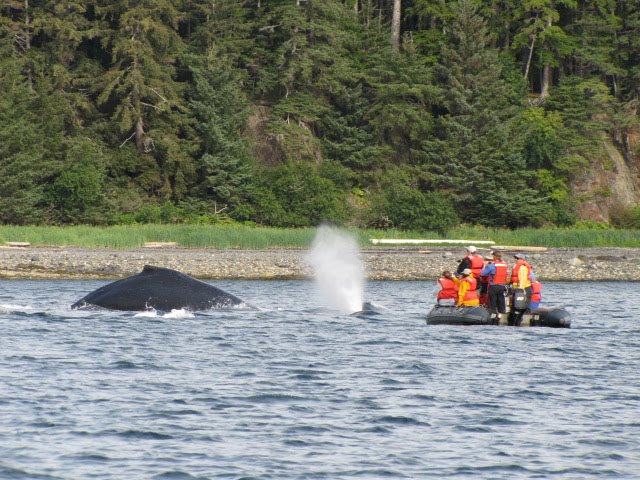
At dusk, we encountered a dozen humpback whales feeding. The humpbacks of southeast Alaska are famous for their bubble-netting technique, in which they surround a school of herring with bubbles, drive them to the surface, and then dramatically engulf them. They often work as a team (as we witnessed a few days later), but on this summer eve, they were working solo over a wide area. At times, you could look in any direction and see a humpback feeding or diving to begin again.

We photographers quickly learned that most humpback photos feature their tails as they prepare to dive out of sight.

Note: the middle photograph is by another fellow traveler.

Monday, August 23, 2010

Rivers of Ice


On Friday night, we boarded M/Y Safari Quest, our home for the next seven days. Technically, we were on a cruise, but it bore little resemblance to traditional cruises. With just 21 passengers, the Quest can go places that 2,000-passenger ships can't.


Case in point: our visit to Dawes Glacier at the top end of Endicott Arm. Our voyage up the arm got off to an early start on Saturday morning, as an incoming iceberg forced the crew to raise anchor (noisily) at 4:45am. After that, we cruised amidst increasing numbers of white and blue icebergs, fresh from the glacier.


Dawes is a tidewater glacier--it reaches the sea, which melts the ice, often in dramatic fashion. Sometimes the front of the glacier falls into the water; such calving can send up large waves - a real risk for unwary kayakers.

Then there are the sliders, which fall off of the sides where the glacier meets the shore line. And best of all are the shooters, pieces of ice that come rocketing up from the depths from submerged parts of the glacier.


Here's John Muir (Travels in Alaska) on shooters:

But the largest and most beautiful of the bergs, instead of thus falling from the upper weathered portion of the wall, rise from the submerged portion with a still grander commotion, springing with tremendous voice and gestures nearly to the top of the wall, tons of water streaming like hair down their sides, plunging and rising again and again before they settle in perfect poise, free at least, after having formed part of the slow-crawling glacier for centuries.


Harbor seals seem to favor tidewater glaciers; we saw many of the skittish critters as we kayaked among the fresh icebergs.

Note: The photos of kayakers in front of Dawes Glacier and of seals on the ice flow are by fellow travelers.

Sunday, August 22, 2010

Juneau's Natural Side - Shrine, Salmon, and Flume


Our second stop in the Juneau area was the Shrine of St. Therese, the patron saint of Alaska. The shrine is hidden in a grove of trees at the end of a small peninsula. The approach feels like something out of fairy tale, with the forest suddenly revealing a charming stone chapel.


On the way back from the Shrine, we were interested in seeing more salmon, so our cab driver Rod took us to the stream that runs by Juneau's fish hatchery. The stream was full of pink and chum salmon. Or, if you prefer, humpback and dog salmon (every Pacific salmon species has at least two names). You can see some of their backs in the photo as they work their way upstream by the gulls.


Pacific salmon die after they spawn. Their spent bodies provide a bonanza for the gulls, bald eagles, and other critters, not to mention the trees that absorb any remaining nutrients. At times, they also have a certain macabre beauty:


Once back in Juneau, our final activity to hike up from the city and then hike back down along the Gold Creek Flume Trail -- the remains of the wooden aqueduct that once supplied Juneau with water.

Sometimes it has six boards, sometimes four (photo), and sometimes only two.

Friday, August 20, 2010

Juneau's Natural Side - Mendenhall Glacier

Our goal on day two (August 13) was to see as much of natural Juneau as possible. First stop: Mendenhall Glacier in the Tongass National Forest.

We had barely entered the park when a black bear scampered across the road. A good omen for our nature viewing.

Even more exciting was a new sighting for us: a porcupine nestled high in a tree near the visitor center. Not a great photo, but we hope you get the idea.


We beat the crowds so we got to view Mendenhall by ourselves (reminding us of our visit to the Great Pyramid):

Mendenhall has receded markedly since Donald was here in 1988. For those of us from the lower 48, it’s tempting to conclude that contemporary climate change is to blame, but that’s not the whole story. Many of the glaciers in southeast Alaska expanded in the Little Ice Age (approximately 1550 to 1850) and have been receding ever since.

Along the trail, we also spied some excellent birds, including Wilson’s Warbler (which Esther described as "that warbler with the little mohawk") and Ruby-crowned Kinglet (perhaps the cutest bird in North America).

After a quick course in glacierology at the visitor center, we headed down to Steep Creek. After passing a luminous Townsend’s Warbler, we found Sockeye Salmon spawning in the creek. A great chance to watch these bright red salmon compete for nesting spots and mates. The females would turn sideways and wiggle her tail to clear out a nest. The male would track her and try to chase off competing males. And sometimes it seemed the female would fight off other females.

We didn’t see any bears at first, but it was obvious they frequent the area. The scat and a dead salmon provided some forensic evidence, but the real giveaway was the matted-down grass along the creek bank and in strategically chosen routes under the boardwalk.

Just as we were about the get back in our taxi, a woman asked if we had seen any bears. We said no, to which she replied "well there’s one right there.” And right she was. We followed (from the safety of the wooden boardwalk) the yearling black bear as he walked along the bear trails, under the boardwalk, sniffed the dead salmon, and then moved on to fish for a fresh one in private.

The bears pose a challenge for designers: If you build a boardwalk along a salmon creek in bear country, how do you keep the bears off of it? The answer is to put swinging doors at each end of the boardwalk – doors that swing out, which bears allegedly haven't figured out. Yet.

Gold in Alaska

We've been working our way north in recent summers. In 2008, we traveled through Washington and Oregon. Last year, we visited pre-Olympics Vancouver, Victoria, and Whistler. And this year, we headed off to explore the fjords and glaciers of southeast Alaska.

Gold turned out to be the unifying theme of day one of our journey (August 12):

* Perhaps not understanding the idea of vacation, Donald read about the gold standard while flying from DC to Seattle to Juneau (except when he was watching Date Night).

* We learned that Juneau was founded during the Alaskan gold rush. Indeed, Joe Juneau was a gold prospector.

* According to the City Museum (well worth a visit), earlier residents of the area had used gold to make bullets. Apparently many mountain goats and brown bears were shot full of gold rather than lead.

* Gold mining was once Juneau’s primary industry (now it's government). We were told several times that abandoned gold mines stretch for twice as many miles as Juneau’s surface roads (which famously do not connect with the rest of North America).

* We stayed in the Goldbelt hotel (which wins the award for fastest check-in ever -- under one minute).

* We discovered that downtown Juneau is rife with jewelry stores selling diamonds, tanzanite, and, yes, gold to cruise ship passengers.

John Muir famously traveled the fjords of southeast Alaska in the late 1880s. What he wrote about the the nearby city of Wrangell applies just as well to Juneau today:

The shops were jammed and mobbed, high prices paid for shabby stuff manufactured expressly for the tourist trade. … Most people who travel look only at what they are directed to look at. Great is the power of the guidebook-maker, however ignorant.


In the days that followed, we tried to get off the beaten track and see the real southeast Alaska.